Foundation · Node 01
What are the Four Pillars in BaZi?
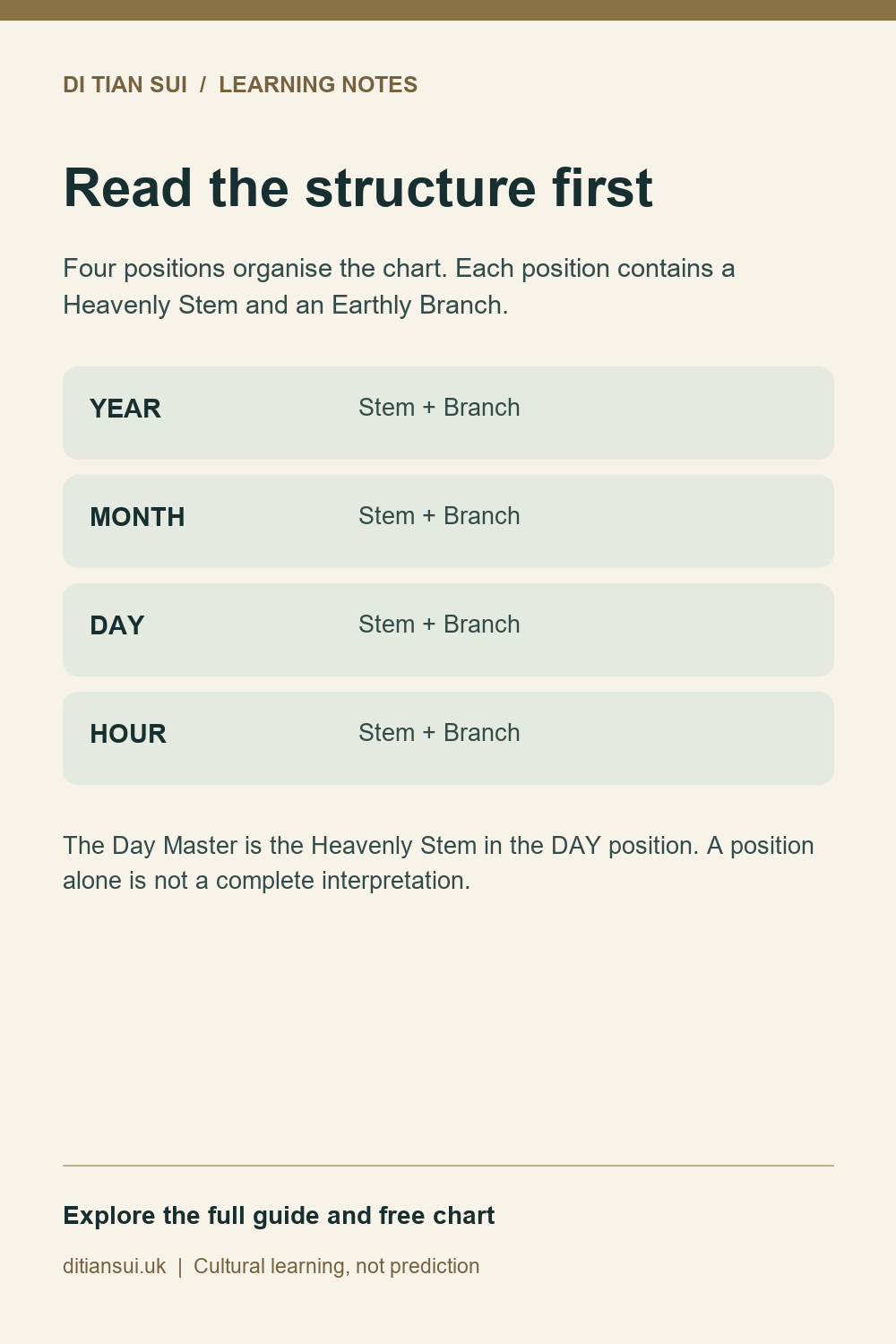
BaZi records four Stem–Branch pairs from the year, month, day and hour of a local birth moment. The eight written signs are facts produced by a stated calendar convention; their meaning comes later.
The fact layer
The Year, Month, Day and Hour Pillars each contain a Heavenly Stem and an Earthly Branch. DI TIAN SUI calculates these first and preserves them unchanged beneath every interpretation.
The traditional reading layer
The pillars are commonly used as different fields of context: inherited or outer context, seasonal environment, the self-and-partnership axis, and inner or later-life direction. These are interpretive frames, not biographies encoded in advance.
The reflection layer
A useful reading asks whether a pattern helps you notice something testable in lived experience. It should not ask you to surrender agency to a formula.
Before calculating, prepare your birth information and record any uncertainty.
See these pillars in my chartHow to read the four columns without guessing
Start with the column labels: Year, Month, Day and Hour. Do not assume that every calculator arranges them from left to right in the same order. In each labelled column, identify the Heavenly Stem and the Earthly Branch. Four pairs give the eight characters referred to by the name BaZi.
- Copy the date, local time and birthplace you actually entered. Keep an uncertain time marked as uncertain.
- Find the Day column and note its stem separately. This is the Day Master reference, not the whole chart.
- Read the other three columns before attempting an interpretation. A year animal alone is not a substitute for all four pillars.
- If two calculators disagree, compare their input and calendar conventions before comparing the prose they produce.
A simple reading exercise
On a sheet of paper, draw four labelled columns and two rows called Stem and Branch. Copy the labels from your generated chart into this grid. At this stage, your task is to identify and check the displayed information, not to predict an event. Keep a second list for interpretations so that a statement such as “this may be useful to reflect on” does not become confused with a calendar calculation.
What if I do not know my birth hour?
Do not turn an estimated hour into a known fact. Write down what is known and what is missing, and avoid treating an invented Hour Pillar as evidence. For practical input checks, use the birth-information guide. The same uncertainty should remain visible in any later reading.
Where do the stem and branch names come from?
The Hong Kong Observatory explains the ten Heavenly Stems, twelve Earthly Branches and their repeating sixty-pair calendar cycle. This supports the calendar terminology; it does not establish predictive claims about personality or future events. See the Observatory’s explanation of stems and branches.
Prepared with AI assistance by DI TIAN SUI. This worked reading exercise is educational and is not a personal forecast.